
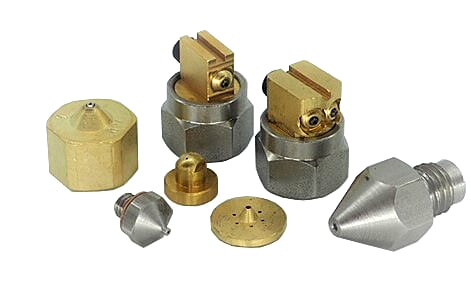
Selecting the correct hot melt nozzle is one of the most important decisions for consistent bond quality, reduced adhesive consumption and fewer line stoppages. The wrong orifice size or pattern can cause pop-opens, stringing, excess squeeze-out or frequent clogging.
Browse Nozzles Need Help Choosing?
1. Start with Your Application Requirements
Before looking at orifice sizes, clarify what the nozzle must achieve:
- Bead or pattern type - single continuous bead, multiple beads, dots, swirl or spray
- Bead width / add-on weight - how much adhesive is required for a reliable bond without excess
- Line speed - faster lines usually need larger orifices or multi-orifice nozzles to maintain volume
- Substrate and joint design - carton sealing, tray erecting, product assembly, labelling, etc.
- Orientation - top-down, side, or angled application
2. Choose the Correct Orifice Size
Orifice diameter has the biggest influence on adhesive flow rate and bead size.
General guidelines
- Smaller orifice (e.g. 0.30-0.41 mm / 0.012–0.016") → less adhesive, finer bead, cleaner cut-off, better for high-precision packaging
- Medium orifice (e.g. 0.46-0.61 mm / 0.018–0.024") → most common for case and carton sealing
- Larger orifice (0.76 mm / 0.030" and above) → higher volume, more tolerant of higher-viscosity adhesives or slight contamination, used where more adhesive is needed
Important: Increasing orifice size by only 0.05 mm can raise adhesive usage by 15-25%. Always choose the smallest size that delivers a reliable bond without clogging.
3. Understand Engagement Length
Engagement (the length of the orifice hole) also affects flow:
- Longer engagement → lower flow rate and often cleaner cut-off
- Shorter engagement → higher flow rate
Many Nordson-style nozzles are available in different engagement lengths (e.g. 1.3 mm, 3.8 mm, 7.6 mm). Matching the original specification is usually the safest starting point.
4. Select the Right Nozzle Style & Pattern
Common styles we stock
- Straight single-orifice - most common for top-down bead application
- Right-angle (90°) - for side or restricted-access applications
- Multi-orifice / button / dome - multiple beads from one nozzle (15°, 30°, 45°, 60° etc.)
- Swirl / spiral nozzles - wide coverage patterns
- Hand applicator nozzles - short or extended tips for manual guns
Multi-orifice nozzles can reduce the number of modules needed and improve pattern consistency, but they require good filtration and clean adhesive to avoid uneven flow.
5. Consider Adhesive Properties
- Higher viscosity or adhesives that tend to char → prefer a slightly larger orifice to reduce clogging risk
- Low-viscosity metallocene or high-performance adhesives → can often run smaller orifices for reduced consumption and cleaner cut-off
- Always maintain correct temperature and filtration (typically 100-mesh) - a clean system is just as important as nozzle size
6. Practical Selection Checklist
- What is the current (or required) bead width / add-on weight?
- What is the line speed?
- Is the application top-down, side, or angled?
- Single bead or multiple beads needed?
- What is the adhesive viscosity and tendency to char?
- What is the existing nozzle part number (if replacing)?
- Do you have good filtration and temperature control?
Tip: When replacing nozzles, start with the same orifice size and engagement as the original. Only move up or down in size after confirming bond quality and consumption.
Need Help Selecting the Right Nozzle?
Adhesive Supplies stocks a wide range of compatible hot melt nozzles for Nordson-style systems (straight, right-angle, button, hand applicator and more) in many orifice sizes and engagement lengths.
Send us your current part number or describe your application (bead size, speed, adhesive type) and we will recommend the most suitable options.
